1953
Egypt

Egyptian independence
In Egypt after the Second World War, discontent with the ruling king and with the prevailing corruption grew. The defeat in the war with Israel in 1949 intensified protests within the officer corps. In the summer of 1949, the secret organization "Free Officers" was created. It was headed by Lieutenant Colonel Gamal Abdel Nasser (1918-1970). In January 1952, anti-British demonstrations ended in clashes. The army turned against the regime. On the night of July 22-23, 1952, the troops of the "Free Officers" entered Cairo. In 1953, the monarchy was abolished, and Egypt was proclaimed a republic. Power passed to General Mohammed Naguib. Naguib became Chairman of the Revolutionary Command Council, with Nasser as his deputy.
However, contradictions between them escalated. Nasser advocated a radical program. In October 1954, an unsuccessful assassination attempt on Nasser was carried out by the Muslim Brotherhood. This opened the way for Nasser to effect changes within the country. In November 1954, Naguib was removed, and power passed to Nasser. On July 26, 1956, Nasser announced the nationalization of the Suez Canal. The canal became closed to Israeli ships. The result was the Suez Crisis of 1956: military actions by Israel, Great Britain, and France against Egypt. The conflict was halted through the efforts of the USA and the USSR. The failure of the intervention ensured the growth of Nasser's popularity in the Arab world.
Nasser was regarded as a leader capable of opposing Western colonialism. His name is associated with the unification of Egypt and Syria into the UAR. Nasser consistently adhered to Arab socialism. The core of his policy was the nationalization of industry and strategic sectors. The social program provided for a minimum wage, free education and medicine, and affordable housing. An agrarian reform was carried out that defended the interests of the peasants. A huge contribution was made to defense capability and the development of industry and infrastructure. In 1960, with the assistance of the USSR, construction of the Aswan Dam began. It was built over 11 years and opened on January 15, 1971. The hydroelectric complex provided half of Egypt's electricity. Nasser sought to limit the influence of religion but recognized Islamic values.
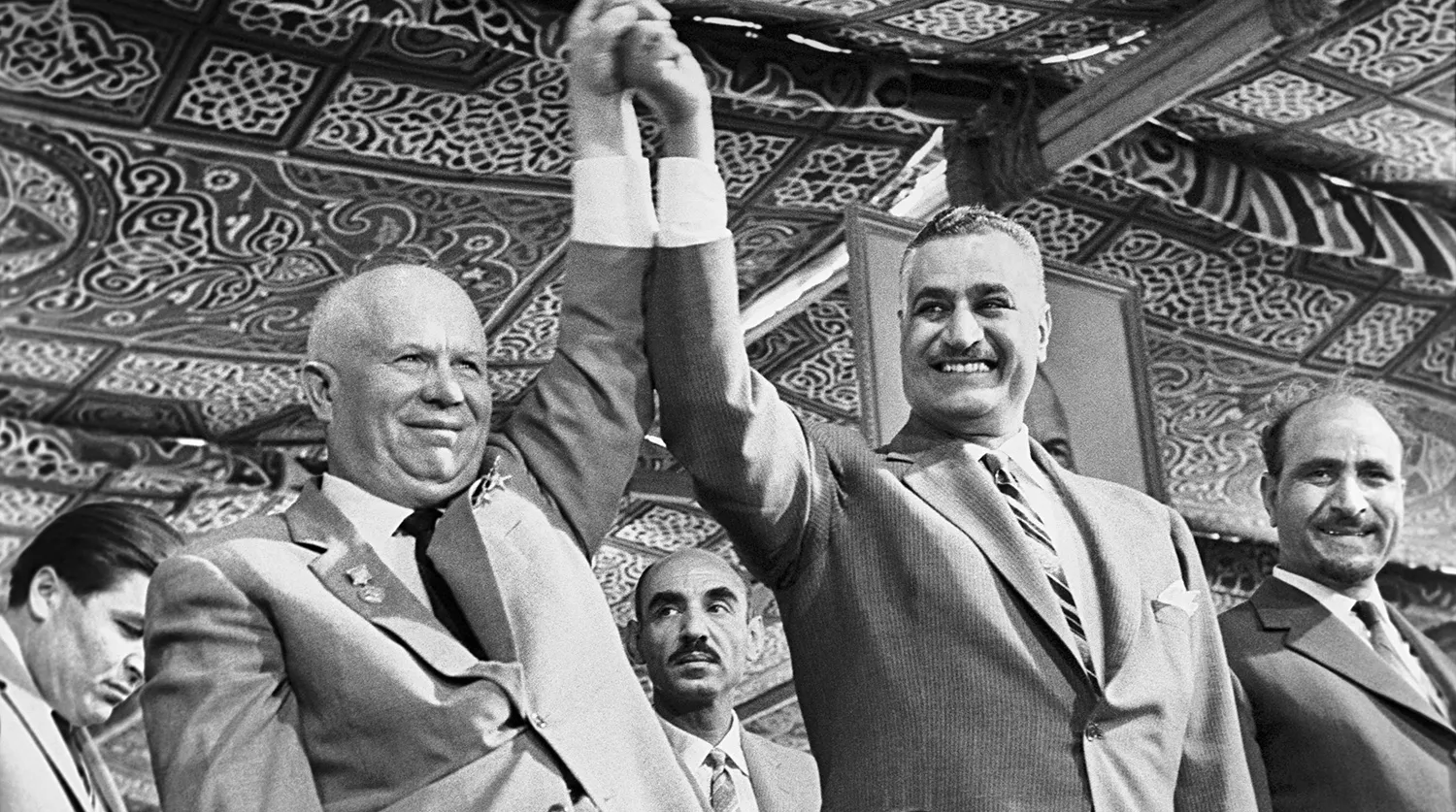
Nasser supported national liberation movements (Algeria, Yemen). Despite suppressing the communists, he maintained good relations with the USSR.
In 1964, Nasser was awarded the title Hero of the Soviet Union. A serious defeat was the Six-Day War in June 1967, where Israel defeated a coalition of Arab countries. On September 28, 1970, Gamal Abdel Nasser died of a heart attack at the age of 52.