Cuba
Cuban doctors
Like many other socialist countries, Cuba achieved impressive successes in education, healthcare, and sports. The heyday of Cuban healthcare came in the 1960s–1980s, when world socialism represented a mighty force and allowed Cuba to develop steadily despite opposition and sanctions from imperialist countries headed by the USA.
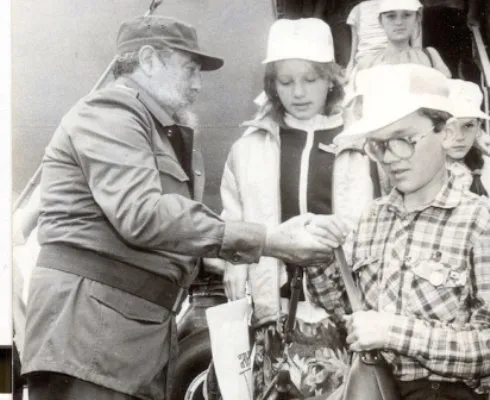
After the disaster at the Chernobyl nuclear power plant on April 26, 1986, Soviet doctors encountered illnesses caused by exposure to radiation. The situation was especially severe with small children who fell within the affected zone, and with those born to mothers exposed to radiation. By 1990 the number of cases of oncology and blood diseases in children began to increase rapidly. The Soviet Union experienced difficulties providing specialized treatment, and on top of that the country had entered a period of deep political and economic crisis. To the call to the world community for help, Cuba responded immediately. A delegation headed by Cuba's chief oncologist, Professor Marta Lichong, departed for Kyiv. On March 29, 1990, two planes with the first batch of sick children and their parents flew to Cuba. At Havana airport they were met personally by Fidel Castro. He announced that the Cuban government had approved a state program "Children of Chernobyl" for the young inhabitants of the affected republics of the USSR and had opened funding. The José Martí Pioneer Camp at Tarará, one of the best on Cuba, was given over to serve as a treatment and recreation center.
While the Soviet Union still existed, the work was set up as follows: Cuban doctors selected children from the affected regions, the USSR Ministry of Civil Aviation provided an aircraft that flew them to Havana. In Cuba, all care for the children fell on the receiving side.
Cuban doctors worked in many countries of the world. From 1960 to 2000, 28,422 Cuban medical workers worked in 37 countries of Latin America, 31,181 in 33 countries of Africa, and 7,986 in 24 countries of Asia. According to UN estimates, in the autumn of 2019 more than 30,000 Cuban doctors were working in 67 countries of the world. From 1998 to 2007, a large group of Cuban doctors worked in Haiti; during this time, health indicators in Haiti improved significantly: in particular, infant and child mortality and maternal mortality were reduced by more than half, and life expectancy increased by 7 years.
In February 2016, the new Honduran government that had come to power announced the termination of medical cooperation with Cuba — at that time 128 Cuban doctors and medical workers were working in Honduras.